
Failure

“Fall down seven times, get up eight.”
– Tadashi Nakamura

In the course of life, we’re all going to fall down.  You might find yourself wavering off of your workout or nutrition plan more than you planned, or you might get fired from a job.  You might have one of those days at the gym where you’re constantly missing easy lifts.  It could be a failure to finish a big crucible event that you’ve been training hard for, as just happened to me!  In all of these situations, there are a couple universal truths. First, as the beginning sentence already laid out, it’s going to happen to everyone — sooner or later, we all fail at something.  Secondly, it’s how you respond to it that counts.

Falls, or failures, whether self-imposed or brought on by things out of our control, can at times be devastating.  But it is important to remember that sooner or later everyone is going to have to face some sort of failure.  We all face them every day to one degree or another, and we usually show resilience by standing back up and pushing through again for success.  When a significant failure occurs, it’s important to not just try to push it aside and move past it, as if somehow it didn’t happen.  Use the failure and the following downtime to find the ingrained lesson.  What can you learn from this and take on board so that it doesn’t happen again?  Maybe you have learned about yourself – a new physical or mental “limit” that you can now use as a goal to push past!

Mark Divine is the founder of both SEALFIT and Unbeatable Mind, two organizations that I very much subscribe to (even when my own often spectacular failures might not show it!)  His karate sensei was Tadashi Nakamura, the man quoted in the beginning of this text with that great quote on resilience.  He has another quote that I stumbled across again recently, which boils down to “One Day, One Lifetime.”  It was the subject of a speech that he gave to his students about simply living each day as if it was your entire life, not taking anything for granted, not wasting any precious energy on being negative, and certainly not dwelling on the past.  That was very eye-opening when I first read it, and I am glad I came across it again.

I’ve started incorporating these two quotes into my daily routine, and I encourage you to do the same.
Each evening, I recount my day in my head and start thinking about the positive things that happened.  Then I think about my failures, even those that were only apparent to myself, and think “Fall down seven times, get up eight.”  I make sure that I “get up” again in my mind, taking the lesson from the failure and moving on positively.
Each morning, as part of my daily planning, I think “One Day, One Lifetime” as a way to remember to make this day count, be positive and stay in the present.  And then I go get it!

Take some time to reflect on a recent failure of your own.  How did you respond?  Hopefully keeping these quotes or a similar mantra that has meaning to you will help you move forward positively!

Ryan
Just Today

Message to myself today, Marcus Aurelius style.


Don’t look too far ahead.  The mountain ahead of you is not meant to be climbed all at once.  It’s meant to be climbed one brutal, determined step at a time.

You don’t need to have it all figured out right now.  It’s OK if you don’t.  It’s not OK if you stop trying to figure it out.  Just keep on showing up, today, with everything you’ve got.

Greatness doesn’t come from some massive breakthrough.  It comes from consistency.  It comes from running one more mile when you’re hurting and no one is watching.  One more mile.  And then another one.

Most people don’t accomplish their goals because they wait until they feel “ready” to start working.  “Maybe tomorrow I’ll feel good, my legs won’t be tired and I can go.”  Readiness is a lie.  Discipline and consistency are keys to success where motivation fails.

Don’t worry about the big goal.  Don’t worry about tomorrow.  Just put out today.  Start in the morning.  Crush a workout.  Make the right choice when the hard decision comes up.  Push through and win when other people would quit.

Then do it again tomorrow.

Ryan

Squat Clinic

Why Squat?

The squat is essential to your well-being. The squat can both greatly improve your athleticism and keep your hips, back, and knees sound and functioning in your senior years.
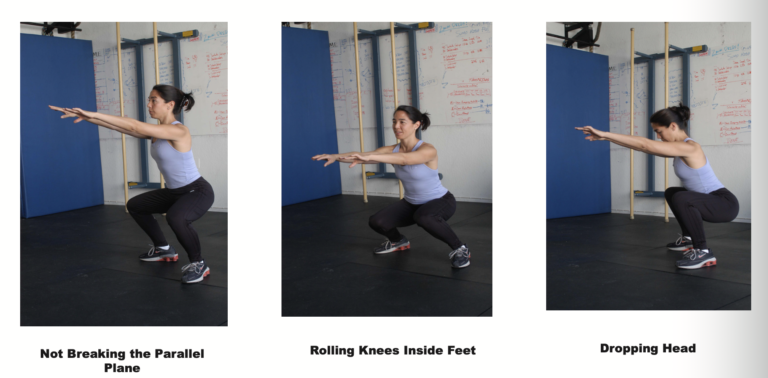
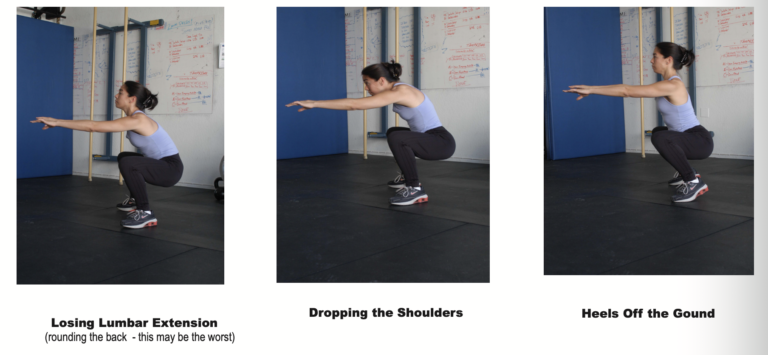
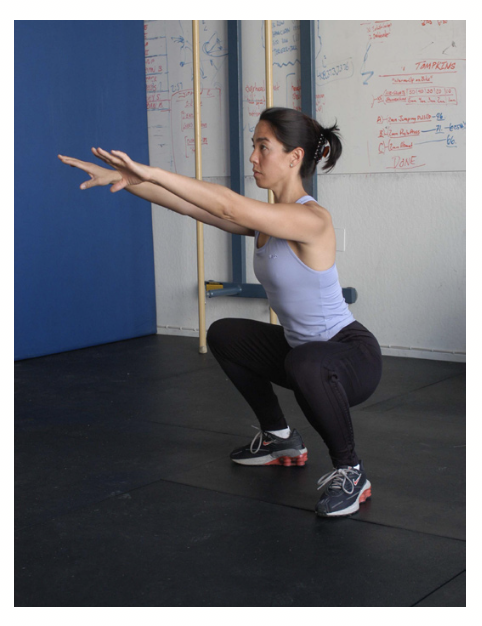
Not only is the squat not detrimental to the knees it is remarkably rehabilitative of cranky, damaged, or delicate knees. In fact, if you do not squat, your knees are not healthy regardless of how free of pain or discomfort you are. This is equally true of the hips and back.

The squat is no more an invention of a coach or trainer than is the hiccup or sneeze. It is a vital, natural, functional, component of your being.

The squat, in the bottom position, is nature’s intended sitting posture (chairs are not part of your biological make-up), and the rise from the bottom to the stand is the biomechanically sound method by which we stand up. There is nothing contrived or artificial about this movement.

Most of the world’s inhabitants sit not on chairs but in a squat. Meals, ceremonies, conversation, gatherings, and defecation are all performed bereft of chairs or seats. Only in the industrialized world that contributes immensely to decrepitude.

Frequently, we encounter individuals whose doctor or chiropractor has told them not to squat. In nearly every instance this is pure ignorance on the part of the practitioner. When a doctor that doesn’t like the squat is asked, “by what method should your patient get off of the toilet?” they are at a loss for words.

In a similarly misinformed manner we have heard trainers and health care providers suggest that the knee should not be bent past 90 degrees. It’s entertaining to ask proponents of this view to sit on the ground with their legs out in front of them and then to stand without bending the legs more than 90 degrees. It can’t be done without some grotesque bit of contrived movement. The truth is that getting up off of the floor involves a force on at least one knee that is substantially greater than the squat.

Our presumption is that those who counsel against the squat are either just repeating nonsense they’ve heard in the media or at the gym, or in their clinical practice they’ve encountered people who’ve injured themselves squatting incorrectly.

It is entirely possible to injure yourself squatting incorrectly, but it is also exceedingly easy to bring the squat to a level of safety matched by walking. In the accompanying article we explain how that is done.

On the athletic front, the squat is the quintessential hip extension exercise, and hip extension is the foundation of all good human met with the capacity to explosively open the hip could also run, jump, throw, and punch with impressive force.

Secondarily, but no less important, the squat is among those exercises eliciting a potent neuroendocrine response. This benefit is ample reason for an exercise’s inclusion in your regimen.

How to Squat

Here are some valuable cues to a sound squat. Many encourage identical behaviors.

  1. Start with the feet about shoulder width apart and slightly toed out.
  2. Keep your head up looking slightly above parallel.
  3. Don’t look down at all; ground is in peripheral vision only.
  4. Accentuate the normal arch of the lumbar curve and then pull the excess
    arch out with the abs.
  5. Keep the midsection very tight.
  6. Send your butt back and down.
  7. Your knees track over the line of the foot.
  8. Don’t let the knees roll inside the foot.
  9. Keep as much pressure on the heels as possible.
  10. Stay off of the balls of the feet.
  11. Delay the knees forward travel as much as possible.
  12. Lift your arms out and up as you descend.
  13. Keep your torso elongated.
  14. Send hands as far away from your butt as possible.
  15. In profile, the ear does not move forward during the squat; it travels straight down.
  16. Don’t let the squat just sink, but pull yourself down with your hip flexors.
  17. Don’t let the lumbar curve surrender as you settle in to the bottom.
  18. Stop when the fold of the hip is below the knee – break parallel with the
    thigh.
  19. Squeeze glutes and hamstrings and rise without any leaning forward or
    shifting of balance.
  20. Return on the exact same path as you descended.
  21. Use every bit of musculature you can; there is no part of the body
    uninvolved.
  22. On rising, without moving the feet, exert pressure to the outside of your feet as though you were trying to separate the ground beneath you.
  23. At the top of the stroke stand as tall as you possibly can.

The Air Squat

All our athletes begin their squatting with the “air squat,” that is, without any weight other than body weight. As a matter of terminology when we refer to the “squat” we are talking about an unladen, bodyweight only squat. When we wish to refer to a weighted squat we training with the front, back, and overhead squats, before the weightless variant has been mastered retards athletic potential.

When has the squat been mastered? This is a good question. It is fair to say that the squat is mastered when both technique and Our favorite standard for fast multiple reps would be the Tabata Squat (20 seconds on/10 seconds off repeated 8 times) with the weakest of eight intervals being between 18-20 reps. Don’t misunderstand – we’re looking for 18-20 perfect squats in twenty seconds, rest for ten and repeat seven more times for a total of eight intervals.

The most common faults to look for are surrendering of the lumbar curve at the bottom, not breaking the parallel plane with the thighs, slouching in the chest and shoulders, looking down, lifting the heels, and not fully extending the hip at the top. Don’t even think about weighted squats until none of these faults belong to you.

Common Faults or Anatomy of a Bad Squat

A relatively small angle of hip extension (flat back), while indicative of a beginner’s or weak squat, and caused by weak hip extensors is not strictly considered a fault as long as the lumbar spine is in extension.

Causes of a Bad Squat

  1. Weak glutes and hamstrings. The glutes and hams are responsible for powerful hip extension, which is the key to the athletic performance universe.
  2. Poor engagement, weak control, and no awareness of glute and hamstring. The most athletes.
  3. Resulting attempt to squat with quads. Leg extension dominance over hip extension is a leading obstacle to elite performance in athletes.
  4. Inflexibility. With super tight hamstrings, you’re screwed. This is a powerful contributor to slipping out of lumbar extension and into lumbar flexion — the worst fault of all.
  5. Sloppy work, poor focus. This is not going to come out right by accident. It takes incredible effort. The more you work on the squat the more awareness you develop as to its complexity.

Therapies for Common Faults

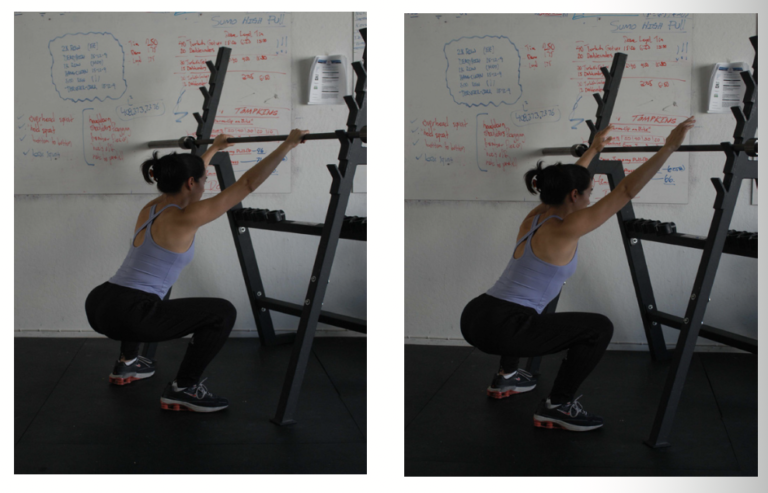
Bar holds: Grab a bar racked higher and closer than your normal reach at bottom of squat, then settle into perfect bottom with chest, head, hands, arms, shoulders, and back higher than usual. Find balance, let go, repeat closer and higher, etc. Lifts squat (raises head, chest, shoulders, and torso) putting more load on heels and glute/hams. This immediately forces a solid bottom posture from which you have the opportunity to feel the forces required to balance in good posture. This is a reasonable shoulder stretch but not as good as the overhead squat. See below. This is a very effective therapy.
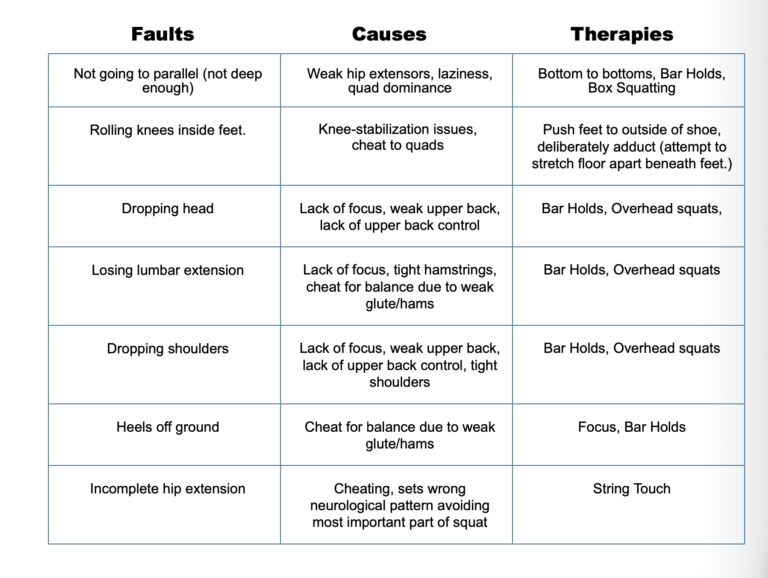
Box squatting: Squat to a 10-inch box, rest at bottom without altering posture, then squeeze and rise without rocking forward. Keep perfect posture at bottom. This is a classic bit of technology perfected at the Westside Barbell Club.

Quick Reference Sheet

Hero Month 2025 COMPLETE

We did it, you guys!  Hero Month is secured for 2025!!

The month culminated with Memorial Day “Murph” which is always a crusher and something that we look forward to in an excited but nervous way as soon as the weather gets warmer.  But this year, as in previous Hero Month years, I feel like you guys all showed up ready to crush rather than be crushed.  The efforts that people were putting out on Murph were incredible, and a testament to the hard work you all have grinded out all month.

Back to the beginning, with “Manion”.  On April 29th we honored USMC 1LT Travis Manion with our annual tradition of 203 back squats and 1.75 miles of running.  What a grueling experience that is, but you guys stepped up on a Tuesday and knocked it out.  I think we were very prepared for it with the 20-rep back squat workouts that Mayhem has been throwing our way this spring too!

We hit a couple workouts that I’ve always personally avoided programming (or doing myself!) because of the tremendous volume of work – “Bull” and “Coffey”.  With both of those, though, we took a page out of Coach Jess’s Saturday WOD playbook and made them partner workouts.  I love that as a way of making longer workouts more accessible to everyone, and we’re still getting a ton of work done.  The feeling of a partner workout is also sneakily intense, like a forced interval workout.  You’re getting some rest, but as soon as your partner is done with their set you have to move, NOW!

Borrowing from Alicia’s awesome Insta post, by the end of the month we did 175 power cleans and 562 pull-ups, and ran 17,200m (10.6 miles).  You try not to have programming biases, but sometimes they sneak out.  But if you didn’t know I like cleans and pull-ups, then you might not be a member at CFKI.  Oh and I still hate running, but part of Hero Month is getting tougher by leaning into hard things.

Can’t wait to get after it again with you all in Hero Month 2026.  It’s never to early to send me your requests for Hero workouts to include next time, or for a Saturday session coming up!

Train hard, stay safe, have fun.

Ryan

Celebrate and Remember, Work Hard and Recover

We’ve had quite a few older members join us recently, which is amazing because I have felt for the past few years that this was the population that we were underserving – retirees, those who suddenly have more time on their hands for fitness and health and are wondering what the hell to do with it.  And I’ve had a few candid conversations with some new members about not reliving “the glory days”, back when you were a gym rat and could squat 500, or you were a competitive rugby player and nothing seemed to hurt the next day.  Now, we (and I’ll grudgingly include myself in this category) have consequences for our ego in the gym or our late-night partying.  It hurts!  And it keeps us out of training the next day, and the day after that.  So I have a couple targeted messages for the membership today.

To the aging athletes and former champions: Be Kind to Yourself.  Remember and celebrate the amazing athletic accomplishments that you have had.  For some of us, it might have even been in the sport of CrossFit, with a sub-4-minute Fran 10 years ago or a 1000-lb Total.  By the way, if you don’t know what those mean, you missed out on some fun times.

Now be patient with your body that has very little wiggle room for injury or burnout if we pour ourselves onto the fire too quickly.  Embrace the future of consistent training with few setbacks, and the goal of living a great physical life, able to do all the things that you want to outside of the gym.

To those that would say they are “in their prime”, Enjoy It!  You know that we did.  Now is the time to accomplish your audacious physical goals, and work hard for them.  But if others’ shoulder reconstructions and early knee replacements could talk, they would warn you against the hubris that you are invincible.  Be smart about your training, and embrace scaling weights and prioritizing range-of-motion as a way to train hard without injury.  Pay attention to how your body feels and add more recovery work rather than more and more miles on the road.  You’ll still crush your 50-miler but it won’t crush you.

I might need a hand off of this soapbox if any of you youngsters are around!

Train hard, stay safe, and have fun.

Ryan

You’ve Never Lived Until You’ve Almost Died

“You have never lived until you’ve almost died. For those who have fought for it, life has a special flavor that the protected will never know.”

  • Guy de Maupassant

This quote has a few meanings for me, and has become more meaningful in the last week because a couple people who have started reading The Comfort Crisis have sent it to me. For them, the meaning is a motivator to get them through their misogi, or a personal hard mission that requires maximum physical and mental effort, and may not even be doable. Hopefully it doesn’t result in death, but with a misogi you never really know. For those who have served in the military or in a first responder capacity, this may be a great reminder of their watchdog role in life that often brings them in harm’s way, and how important that is to their warrior culture.

As we get into Hero Month in May, this quote is also a great reminder of why we are doing these workouts. The Heroes that we are honoring lived their lives in this way – on the edge of life and death every day. They ended up on the wrong side of the equation – they pushed themselves to the brink of the ultimate sacrifice, and then paid it.

During Hero Month, let’s remember this. Let’s remember the man or woman that paid the price for our freedom and comfort, and then let’s get uncomfortable to honor them and their life that they no longer get to live on this Earth.

Ryan

Personal Goals

The Wolf family just arrived in Naples, FL for a little spring break trip down to my mom’s place, and in catching up this morning we started talking about watching The Masters last weekend, and then about playing golf.  My mom’s husband and I always have this same conversation – “are you playing much?”  “Nope, I really want to but I haven’t made the time, you?”  “Same here, haven’t played in a long time.”

And the thing is that I’m serious – I really do enjoy playing golf, and I really do want to play more, but then I don’t.  Why is that?

When we talk about goal setting, we often assume right away that we’re talking about professional goals – either metric-oriented “I want to grow the business by 20%”, or objective-oriented “I want to execute on XX project this year”.  Professional goals are important, they help keep us focused and help to communicate our intentions for the year to our team and upwards to the big boss.  But what about personal goals?  Having a strong set of goals at work but then living life all willy-nilly at home can make for a relatively one-sided life.  It also doesn’t ensure that we’re keeping fun things in our life, things that we’re passionate about and keep us motivated as human beings, not just worker bees.

So this morning I sat down to review the goals that I wrote in my journal in the beginning of the year, and I added one more – can you guess which one?

  1. Be consistent with my morning practice
    1. Refocus each day on acting out of Courage and Love, rather than Fear
  2. Be consistent with my evening practice
    1. Recap the day, find lessons learned and celebrate wins
  3. Prioritize work during the day, so that I can be available for kids’ activities and spend time with my family in the evening
  4. Play more golf!

Bringing it all full circle, as part of Goal #1, I am going to review my 2025 Personal Goals every day in my morning practice, and make sure that I know when the next time is that I’ll get out there and practice or go play golf with some buddies.  It’s something that I really do want to do, so now I’m going to do it!

PS – we’re going to play some intense mini-golf today at PopStroke, a new Tiger Woods-backed venture that has kind of a long-form mini-golf course with sand traps and rough like a real course.  Looks pretty sweet!

Ryan

Train with Intent

It’s OK to scale.  We know that – if we didn’t then we would consistently not finish workouts because the weights are just too damn heavy or the movements too difficult.

It’s also OK to not train everyday at a balls-to-the-wall competition pace.  Do we know that?  Many of our “seasoned” athletes do, because they know that if they come into the gym for an Open workout on Friday, they need the whole weekend off or even more in order to just stumble back in for a light movement day.  What can we learn from that?

BACK IN THE DAY when I first started in the CrossFit space, the workout cadence was 3 days on, 1 day off.  Go as hard as you can for 3 days, and then take a full day off to recover and nurse your wounds.

These days, we’re into more of a 6 days on, 1 day off mentality, if you want to maximize your Unlimited membership and get invited into the Committed Club.  And I love that… but…

You can’t compete every day.  You can’t effectively compete even two days in a row, unless you’re actually in a competition and you have to – aka the CrossFit Games or the online semifinals leading up to it.  So if you’re coming to the gym 6 days a week, what are you supposed to do?  Our own “seasoned” veteran of CrossFit and competitive rubgy, Tod Grantham, offered to research the subject and found that this ratio of training volume works well:

    • Training (70-80%) – This is where most of the volume occurs, focusing on building strength, endurance, and movement quality. Training should include progressive overload, skill refinement, and metabolic conditioning. The goal is to develop a solid foundation without overtaxing the nervous system or increasing injury risk.
    • Practice (10-20%) – This is lower-intensity work focused on refining technique, movement efficiency, and skill acquisition. Sessions here prioritize deliberate practice rather than maximal exertion.
    • Competition Effort (5-10%) – High-intensity efforts that simulate competition conditions. These workouts are mentally and physically taxing and should be used sparingly to avoid burnout or excessive fatigue before actual competition.

Do you find yourself always in “Competition Effort” mode when you come into the gym?

Do you dread coming to the gym because you think you need to compete?

Do you have to take extra, unplanned rest days because you’re too sore and too fatigued?

The Open is behind us, and we crushed it.  Competition, done.  Let’s spend some time now refocusing our efforts on training, and practicing.  Once in a while, if you’re feeling like a champ and the workout is in your favor, maybe we go ahead and turn it up to 11 and COMPETE.  But most of the time when you’re in the gym, I want you to focus on TRAINING and PRACTICING, so that when the time comes, you are primed to COMPETE.

Using the ratios above, if you come to the gym six days a week, 4 days should be TRAINING – working hard and getting a good sweat in but not to the point of failure.  1 day should be PRACTICE – focus on building a skill.  And 1 day should be dialing it up to COMPETE.

Thank you Tod for the research and prompting this important point.  And thank you all for being intentional with your training.

Train smart, train safe, get awesome.

Ryan

Why I Write

For the accolades, of course!

Just kidding, but since you mentioned it, we were just included in a list of “Top CrossFit Blogs” by FeedSpot, a website that tracks and consolidates blogs from all kinds of industries.  We’re number 44!  I know, super impressive number, but I took a pause to be grateful for that, gave myself a couple fistbumps, and then reflected on why I started this CrossFit Kent Island blog and why I like writing in the first place.

First of all, it’s for our community.  I enjoy writing to you guys because it’s a way that I can consistently communicate what’s going on and how I’m feeling about it to our greater CFKI community.  I know everyone that receives these weekly email messages.  For some of you, I coach you on a daily/weekly basis live in a CrossFit class or on a personal basis.  But for others, I might have “on-ramped” you but don’t see you very often.  I like the chance to be able to reach out with my personal message and hope that you read it so that we can all stay connected as a community.  It’s important for me to keep our CFKI culture strong and focused on positivity, hard work, personal growth, and service.  That culture is what has kept us alive and growing as the years have gone by, and as I take more of a backseat and let our coaches coach while I focus more on the business side and bury myself in spreadsheets, I want to feel as though I still have a pulse on the community and that I’m making an impact with you personally.

Secondly, it’s for me.  I feel that my purpose in life as a coach and a parent of two teenagers (wow!) has morphed into that of a teacher.  And I love it – I think in a past life I was probably a high school biology teacher who spent weekends diving in the southern California coastline, exploring for new creatures (and hunting for sharks).  And so now when I’m not coaching or writing, I spend my time reading.  I read because I want to gain more knowledge and then pass it on to others.  When I read, I think about how these authors write – their language, their persuasiveness, their tone.  Then when I write these blog posts, I am flexing my writing muscles and trying to get better, trying to use what I have read to be more informed, and more persuasive, maybe even funnier?  Writing on a daily basis in my journal or online is a way for me to keep practicing and keep getting closer to my purpose as a teacher.

I have been writing for 13 years now on the CFKI blog, and our first post is right here!  You can see we started from humble beginnings – we didn’t even have a space yet!  But I already KNEW that we would be successful if we could just keep getting one or two new members per month, and so I kept writing…

I hope you enjoy these blog posts as much as I enjoy writing them.  Maybe I’ll keep it going!!

Ryan

Why I’m Signing Up for the Open – and You Should Too

If you haven’t smashed the registration button for the 2025 CrossFit Open yet, you’re probably in one of two camps.  Either you’ve done the Open before and you just haven’t made the plunge again yet (it starts in 3 weeks, you have some time), or you’ve never participated in the Open and you might not really know even what it’s all about.  So, let me address these two groups separately.

If you’re a CrossFit Open veteran (how many years?), you know what’s about to go down – the best three weeks of the CrossFit year.  True, you might get immediate whiplash PTSD if I mention the workout that crushed you the most, but we love the Open for the challenge that it represents, and the community spirit that floods the gym more than ever.
If you haven’t signed up yet, maybe you’re a bit disappointed still in the way that CrossFit HQ handled the death of Lazar Dukic at last year’s CrossFit Games?  I know that I am, I feel like a lot more should have been done to address the lack of risk mitigation in that event, and that goes all the way to the top.  However, I am signing up for the Open, because to me the Open is not about the CrossFit Games – I have never aspired to be a Games athlete.  For those that do have that dream this year, the Open is a must as the first stage of competition against their peers.  But for me, the Open is an annual test that I plan for and must take on, because it’s a chance to compete with MYSELF.
If you’ve completed the Open once before or ten times, you have historic data on the state of your fitness in those years.  Now is your chance to once again take on the challenge and with brutal honesty, see where you stack up.  After the Open, you can make an assessment – are you more fit now?  Less fit?  Why?  Which types of workouts or movements tripped you up this time, and which ones did you excel at compared to last year?  Don’t miss out on this year’s challenge and the opportunity to collect more data.

If you have never completed the Open, don’t read too much into anything above that makes it sound difficult, it’s not – it’s really easy!  Hehehehe… No, it’s not easy, but it’s fun, and it’s challenging, and you should do it because everyone else is and you don’t want to be left out.  The Open, like any CrossFit workout, is designed to challenge all participants relatively.  To that end, for each of the three weekly workouts there will be an “Rx” version for experienced athletes, a “Scaled” version with movements that most people can complete, and a “Foundations” version for beginners.
We will also make the Open an awesome CFKI community event with our annual Intramural Open!  Anyone that would like to participate will be placed on a team, and the teams will compete each week for points.  You can get points for completing the Open workout, and for other fun challenges in and out of the gym.  More on the Intramural Open soon!

The Open starts on Thursday, February 27th when CrossFit will announce the first workout at 3pm Eastern.  Register here for the Open!  Let’s do it!